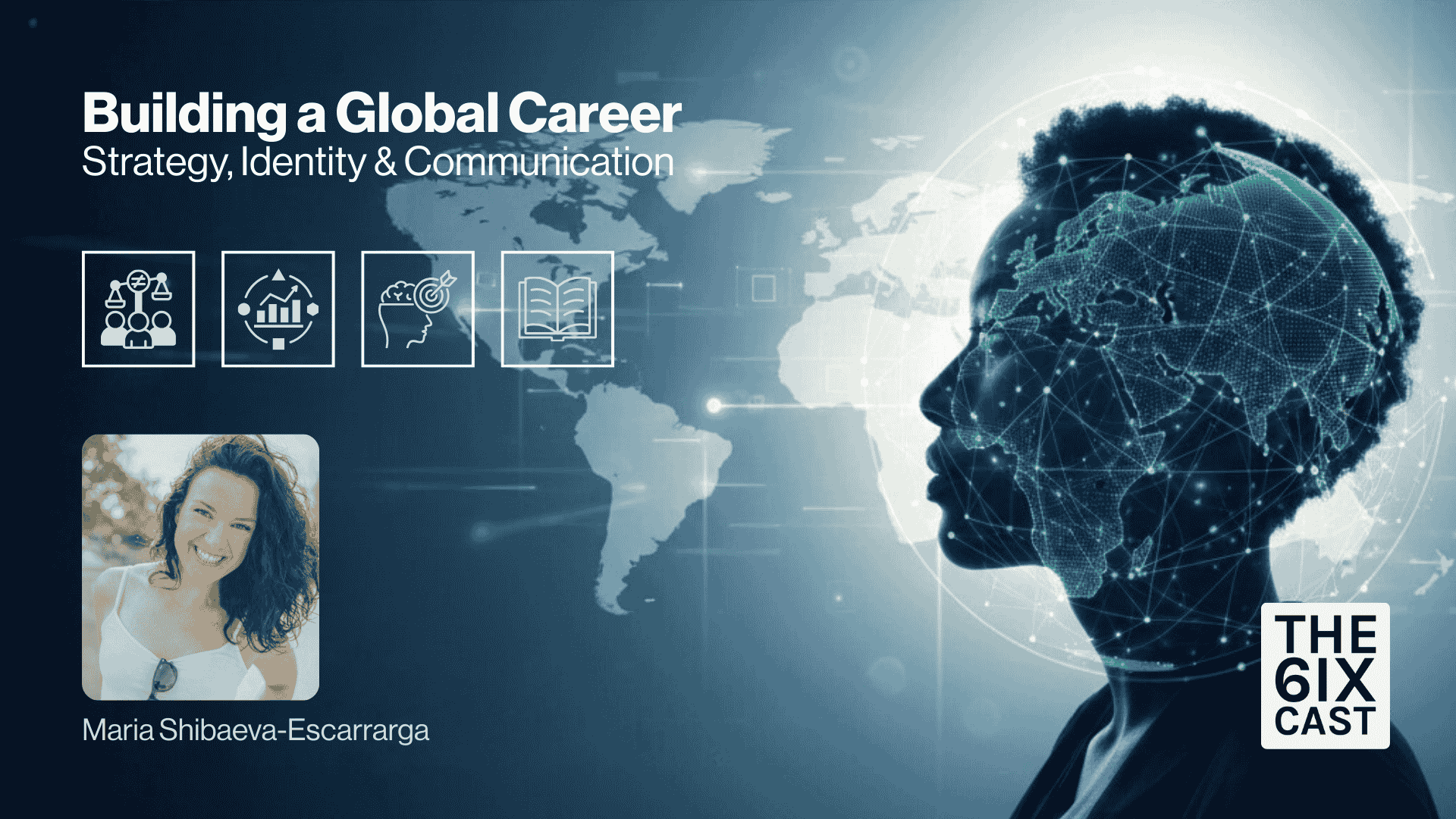
Building a Global Career: Strategy, Identity & Communication with Maria Shibaeva-Escarraga
Careers rarely follow a straight line anymore. They cross borders, shift industries and evolve alongside technology, culture and personal circumstance. Building a meaningful global career today takes more than technical expertise. It requires intention, adaptable communication and a clear sense of who you are.
In this episode of 6ixCast, host Waruna Kulawansha sits down with Maria Shibaeva-Escarraga, an award-winning educator, TEDx and Harvard speaker, former P&G Brand Director and faculty member at the University of Toronto, to unpack what it truly means to thrive across borders and industries.
This conversation goes beyond career advice. It shares practical guidance on building a sustainable career in a global world and provides practical insight into global career strategy that also aligns with the United Nations Sustainable Development Goals (SDGs), especially Quality Education (SDG 4), Decent Work and Economic Growth (SDG 8) and Reduced Inequalities (SDG 10).
Career Strategy in an Unpredictable World
One of the central themes Maria highlights is the misconception that careers should follow a rigid linear path. While professionals are trained to think strategically at work, many default to reacting rather than planning when it comes to their own lives.
As Maria observes:
“Often we’re very strategic at work, but in life, we aren’t very strategic. We just go with the flow.”
Rather than advocating rigid long-term plans, she encourages a balance between intention and flexibility. Maria speaks about thinking in shorter cycles (what comes next, what matters now, and what aligns with one’s broader life priorities) while staying open to opportunities that may not fit neatly into a predefined plan.
She is clear about her discomfort with distant certainty:
“I don’t believe in 15 or 20-year plans. Who knows what will happen?”
For professionals navigating career development in Canada, where the labour market is shaped by immigration, economic shifts and rapid technological change, this approach offers a realistic and sustainable way to think about career progression.
Transferable Skills are the Real Currency of Global Careers
Maria has worked across corporate leadership, academia, consulting and public speaking. That range has shaped how she thinks about careers. She encourages people to build skills that move with them, instead of defining themselves by one job or industry.
Throughout the conversation, she returns to the same core skills: critical thinking, adaptability, self-management, leadership and communication. Among them, communication stands out as essential in almost every situation:
“Clear communication — can you articulate your point of view and your key supporting points clearly and effectively?”
Maria also reminds students and professionals that permanence is rare in modern careers:
“Whatever you do is not going to be forever.”
This perspective reinforces the importance of lifelong learning and supports SDG 4, which focuses on education that prepares people not just for their first job, but for multiple transitions over time.
Knowing Your Market Worth Before You Need It
Another practical insight from the episode centres on career inflection points –i.e., moments when individuals consider changing roles, industries or even stepping back to reassess.
Maria’s advice is grounded and pragmatic:
“It’s always easier to make a change while you’re feeling secure.”
She speaks about the value of staying connected to the market through networks, feedback and self-awareness. Not necessarily to leave a role. But to understand one’s marketability and options. This reduces the shock of unexpected change and allows people to make intentional decisions rather than reactive ones.
For immigrants, entrepreneurs and career switchers, this awareness can be particularly empowering and closely linked to conversations around career development Canada and economic inclusion.
Communication as a Leadership Skill
Throughout the conversation, communication emerges as more than a soft skill. It becomes a leadership capability that enables trust, influence and collaboration. An essential dimension of multicultural leadership in today’s workplaces.
Maria summarizes it succinctly:
“Communication is intention and confidence.”
Communication does not depend only on what is said. How a message is delivered often makes the biggest difference. Confidence, clarity, tone, body language and intention all influence how the message is received.
This becomes especially important in multicultural and global contexts, where meaning can easily be lost in translation. Maria’s experience navigating different cultural norms, particularly around feedback, highlights the need for cultural intelligence, empathy and explicit communication of expectations.
When leaders adapt their communication with intention and without losing authenticity, they can guide others, manage tension better and build inclusive and productive teams. These capabilities support SDG 8’s focus on decent work and sustainable economic growth.
Personal Branding Without the Facade
Personal branding is frequently misunderstood as self-promotion. Maria reframes it as clarity –i.e., knowing what you stand for and how your experiences connect into a coherent story.
She encourages people to start with humanity:
“Before you get into the work, start with the personal.”
This approach creates trust and relatability, notably in leadership, education and consulting. Rather than presenting a polished facade, Maria advocates for authenticity and vulnerability, recognizing that people connect more deeply with humans than with perfection.
Multicultural Identity as a Strength
One of the most resonant parts of the episode is Maria’s reflection on identity. Having lived and worked across several countries, she speaks openly about the tension of belonging and reframes it as growth.
“You don’t change who you are, but you evolve.”
For many professionals in Canada, this insight feels deeply familiar. Integration does not require erasure. Instead, identity becomes layered. Shaped by experience, adaptation and values. This perspective reinforces social inclusion and supports SDG 10.
AI, Lifelong Learning and Career Resilience
The episode closes by exploring how AI and careers are increasingly intertwined. Maria approaches the topic with clarity and calm, positioning AI as a tool rather than a threat.
She encourages professionals to be proactive learners and draws a clear boundary around authenticity:
“Whatever output you put needs to be your own words.”
AI can support research, ideation and efficiency. But it should never replace judgment, voice or values. This balanced view strongly aligns with SDG 4’s emphasis on lifelong learning and responsible technology use.
Careers Built with Intention
This episode of 6ixCast goes beyond practical advice. It offers a perspective on what it really takes to build sustainable careers in a world shaped by constant change.
Maria Shibaeva-Escarraga’s insights remind us that meaningful careers are not built through rigid plans or perfection. They grow through intention, adaptability, honest communication and a willingness to evolve, while staying grounded in who we are.
Watch the full 6ixCast episode for Maria’s insights.


