Artificial Intelligence Is Not What You Think
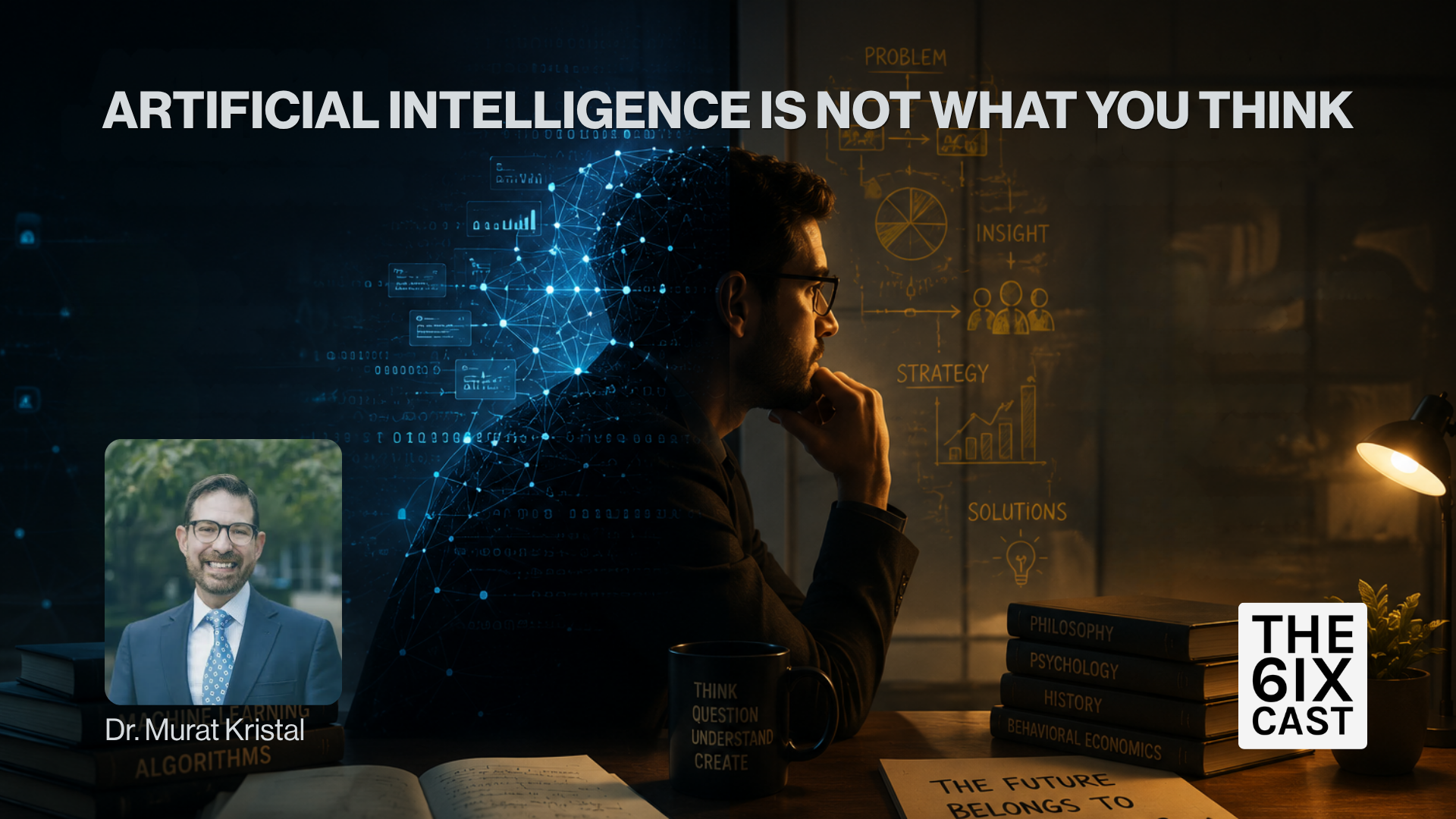
Dr. Murat Kristal on AI, Critical Thinking & the Future of Work
Artificial Intelligence is dominating conversations around the world. Businesses are racing to adopt it. Professionals are questioning what it means for their careers. Industries everywhere are trying to understand how deeply this technology will reshape the future of work.
But beneath all the excitement, there is a question few people are asking: Do we really understand what Artificial Intelligence is?
In this episode of 6ixCast, host Waruna Kulawansha sits down with Murat Kristal, Professor at the Schulich School of Business, Executive Director of the Institute of Digital Business and Program Director of the Schulich Tech MBA.
Drawing from years of experience in analytics, machine learning and digital transformation, Dr. Kristal challenges many of today’s biggest assumptions about AI, work, education and what it truly means to stay relevant in an increasingly automated world.
This conversation goes far beyond technology. At its core, it is about understanding what uniquely human capabilities will matter most in the years ahead.
Artificial Intelligence Is Not Really Intelligence
One of the most thought-provoking parts of the conversation begins with a simple but powerful challenge: what if Artificial Intelligence is not actually intelligent in the way humans think it is?
Dr. Kristal argues that much of what we call AI today is fundamentally large-scale pattern recognition rather than genuine intelligence.
As he explains:
“It’s more about understanding and recognizing these patterns that are in our large datasets.”
Modern AI systems process enormous volumes of existing data, identify patterns and generate outputs based on those learned structures. While these systems can appear highly sophisticated, they are still fundamentally dependent on the information they have already been trained on.
This distinction is important because much of the public conversation around AI assumes machines are thinking independently, when in reality they are largely predicting based on existing information.
Understanding that difference changes how we should think about both the opportunities and limitations of AI.
Why AI Is Reshaping Jobs Faster Than Expected
As AI capabilities continue improving, concerns around job displacement are growing rapidly, particularly in software engineering, accounting, law and other knowledge-based professions.
Dr. Kristal acknowledges that anxiety is justified. Many jobs contain highly repetitive tasks that can now be completed significantly faster by machines.
He puts it simply:
“The repetitive tasks that give you comfort can be done by a machine.”
But rather than viewing this as the end of professional work, he frames it as another major technological transition, similar to how industrial automation transformed manufacturing during earlier generations.
The real shift is not that humans are becoming obsolete. Instead, repetitive work is being automated, forcing professionals to focus on the parts of work that machines cannot easily replicate.
The Real Competitive Advantage Will Be Human Thinking
One of the strongest takeaways from the conversation is that future career security will depend less on technical execution and more on human judgment.
Coding, reporting, document drafting and administrative work may increasingly become automated. But the deeper work behind solving real-world problems remains fundamentally human.
As Dr. Kristal explains:
“The important parts of your job are actually your problem-solving skills.”
The ability to connect ideas, understand systems, analyze situations from multiple perspectives and make sound decisions will become far more valuable than simply performing repeatable tasks.
For professionals entering the workforce today, this shift changes the question entirely.
The future is no longer about what tasks can you perform?
The future is about what problems can you solve?
Education May Be Teaching the Wrong Things
As AI changes the nature of work, the conversation naturally turns toward education.
Dr. Kristal raises an important concern: modern education systems mostly train people to produce answers rather than understand how systems actually work.
Students are frequently taught formulas, processes and frameworks designed to produce correct outcomes. But real learning happens when people understand the underlying system behind those answers.
He explains:
“When you understand how it worked, that stays with you.”
This distinction becomes critical in an AI-driven world.
If technology can instantly generate answers, simply memorizing processes becomes far less valuable. Understanding systems, context and cause-and-effect relationships becomes the real advantage.
This could be one of the biggest educational challenges of the next decade.
The Danger of Using AI Without Thinking
Throughout the conversation, Dr. Kristal repeatedly returns to one central concern: people are increasingly outsourcing thinking itself.
AI tools can now answer questions, write reports, summarize information and generate solutions almost instantly. But relying on these systems blindly creates long-term risks.
As he warns:
“You literally removed yourself from the learning process.”
The problem is not using AI.
The problem is using AI without understanding the underlying problem you are trying to solve.
Strong professionals of the future will not simply use AI tools to generate answers. They will know how to question those answers, evaluate different perspectives and combine insights thoughtfully.
Technology should accelerate thinking. It will not replace it.
Critical Thinking Is Becoming More Valuable Than Technical Skills
One of the most compelling parts of the discussion focuses on critical thinking.
As convenience and automation continue expanding into daily life, people are becoming increasingly dependent on technology for even the simplest forms of decision making.
This dependency creates an uncomfortable reality.
The less we practice problem-solving independently, the weaker those skills become over time.
Dr. Kristal argues that true long-term value will come from maintaining curiosity, questioning assumptions and learning how systems work at a deeper level.
In many ways, AI is forcing people to rediscover skills society may have slowly neglected for years.
The Future Belongs to Curious People
Toward the end of the episode, Dr. Kristal offers simple but powerful advice for students, professionals and leaders trying to navigate the next decade.
His advice is strikingly simple:
“Read. Read. But slowly.”
But the deeper message goes far beyond reading itself.
In a world moving faster than ever, people feel pressured to constantly keep up. Information is consumed quickly, attention spans are shrinking and technology encourages speed over understanding.
Dr. Kristal argues the opposite.
The professionals who thrive in the future will be those who slow down enough to deeply understand systems, ideas, history, philosophy and the context behind complex problems.
Curiosity, patience and deep learning can become some of the most valuable skills in the AI era.
Staying Human in an AI-Driven Future
This episode of 6ixCast is not really about Artificial Intelligence alone. It is about understanding what makes human intelligence valuable in the first place.
Through his insights on machine learning, education, workforce transformation and critical thinking, Murat Kristal reminds us that the future will not belong to those who simply know how to use AI tools.
It will belong to those who understand how to think independently, solve meaningful problems and continuously learn in a world increasingly shaped by automation.
As technology evolves, perhaps the biggest lesson is surprisingly simple: becoming more dependent on machines should never come at the cost of becoming less human.
Watch the full 6ixCast episode to hear Murat Kristal’s insights on AI, critical thinking and the future of work.


